Online Degree Courses 2026

Iaodl

online mba admission 2026

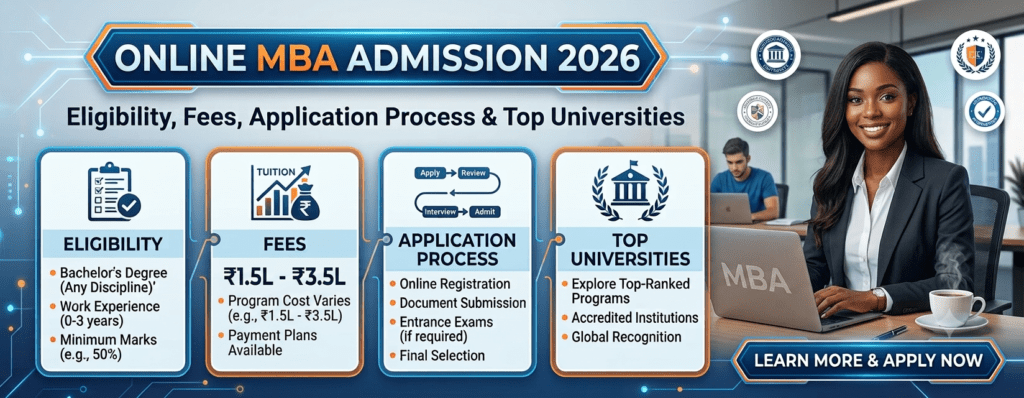
Online MBA Admission 2026: Eligibility, Fees, Application Process & Top Universities

ONLINE MBA ADMISSION 2026 Online MBA Admission 2026: Eligibility, Fees, Application Process & Top Universities Get a clear overview of Online MBA Admission 2026, including eligibility, fee structure, application process, popular specializations, university options and career opportunities. View Admission Process Explore Universities Online MBA 2026 — Quick Facts DurationUsually 2 Years ModeOnline / Distance Learning EligibilityGraduation from a recognized institution SpecializationsMultiple career-focused options ON THIS PAGE Online MBA Admission 2026 Overview Eligibility Criteria Online MBA Fees Application Process Top Universities Popular Specializations Online MBA vs Regular MBA Online MBA Without CAT Career Opportunities FAQs Online MBA Admission 2026: Quick Overview An Online MBA is a postgraduate management programme designed for graduates and working professionals who want to develop business and management skills without attending a conventional full-time campus programme. Flexible Learning Study through online classes and digital learning resources according to your schedule. Career-Focused Curriculum Build knowledge in management, finance, marketing, HR, operations and other business areas. Suitable for Professionals Continue working while pursuing a postgraduate management qualification. Important: Admission requirements, fees, entrance-test requirements, programme structure and recognition can vary by university. Always verify the current 2026 admission notification before applying. Online MBA Eligibility Criteria 2026 Candidates generally need to meet the university’s minimum academic requirements before applying for an Online MBA programme. A bachelor’s degree from a recognized university or institution. The minimum graduation percentage or CGPA may vary by university. Some universities may accept candidates from any academic stream. Entrance-test requirements, if applicable, depend on the university and programme. Working professionals may also apply where permitted by the institution. Tip: Check the official admission notification for the exact eligibility criteria applicable to your chosen university and programme. Online MBA Fees 2026 Online MBA fees differ according to the university, specialization, programme structure, facilities and payment options. Fee Component What It May Include Important Note Programme Fee Tuition and academic delivery Varies by university Examination Fee Semester / term examinations May be included or charged separately Application Fee Application processing Depends on the admission policy Additional Charges Learning resources or other services Check the official fee structure Online MBA Admission Process 2026 The application process can vary from one university to another, but the following steps are commonly followed. 1 Choose Your University & Specialization Compare programme structure, eligibility, fees, curriculum and career relevance. 2 Check Eligibility Confirm that you meet the academic and other admission requirements. 3 Complete the Application Form Enter your personal, academic and contact information carefully. 4 Upload Required Documents Submit the documents requested by the university in the prescribed format. 5 Pay the Applicable Fee Complete the application or programme-fee payment as instructed. 6 Admission Confirmation After verification and approval, follow the university’s instructions to begin the programme. Top Universities Offering Online MBA in 2026 When comparing Online MBA universities, do not look only at the fee. Evaluate programme recognition, curriculum, faculty, learning platform, student support, examination process, placement or career services and overall reputation. University / Institution What to Compare Best For University Option 1 Curriculum, fee, support and recognition Career-focused learners University Option 2 Specializations and learning flexibility Working professionals University Option 3 Academic resources and student services Management aspirants Before publishing university names: Replace the sample rows above with the universities actually promoted by IAODL and verify their current 2026 programme details. Popular Online MBA Specializations in 2026 Students can choose a specialization based on their existing experience, career goals and interest area. Marketing Digital marketing, branding, consumer behaviour and sales. Finance Financial management, investment and corporate finance. Human Resource Management Talent acquisition, employee relations and HR strategy. Operations Supply chain, process management and business operations. Business Analytics Data-driven decision-making, analytics and business intelligence. International Business Global markets, international strategy and cross-border business. Online MBA vs Regular MBA Factor Online MBA Regular MBA Learning Mode Online / digital learning Classroom / campus-based Flexibility Generally higher Generally lower Work While Studying Often suitable for working professionals May require full-time attendance Campus Experience Limited or different from campus programmes Traditional campus experience Is CAT Required for Online MBA Admission? CAT is not universally required for every Online MBA programme. Admission criteria are determined by the individual university. Some programmes may have direct or merit-based admission, while others may specify an entrance test or additional requirement. Therefore, students should check the admission requirements of the specific university before submitting an application. Career Opportunities After an Online MBA An Online MBA can help learners build management knowledge relevant to a range of business functions. Career outcomes depend on qualifications, specialization, professional experience, skills and the employer. Marketing Manager Marketing strategy, campaigns, branding and growth. Business Development Sales strategy, partnerships and revenue growth. HR Manager Talent, people operations and organizational development. Financial Analyst Financial planning, analysis and business reporting. Operations Manager Process improvement, supply chain and operations. Business Analyst Business insights, reporting and data-supported decisions. Why Choose an Online MBA in 2026? Flexible learning for students and working professionals. Opportunity to develop management and business skills. Access to digital learning resources from different locations. Specialization options aligned with different career interests. Potential to continue professional work while studying, subject to programme requirements. Frequently Asked Questions About Online MBA Admission 2026 What is the duration of an Online MBA? Most Online MBA programmes are structured over around two years, subject to the university’s rules and academic schedule. Who can apply for an Online MBA? Graduates who satisfy the eligibility criteria of the selected university can generally apply. Exact requirements vary by institution. Can working professionals pursue an Online MBA? Yes. The online format is designed to provide greater flexibility, although students should review the class, examination and academic requirements of the programme. Is CAT mandatory for Online MBA admission? Not for every programme. Entrance-test requirements vary by university, so applicants should check the specific 2026 admission criteria. How much does an Online MBA cost? Fees vary significantly by university and programme. Check the latest official fee structure before applying. Which Online MBA specialization should I choose?

Online MBA Admission 2026: Eligibility, Fees, Application Process & Top Universities Read More »

degree courses

Which degree course has the highest salary in India?

Which degree courses has the highest salary in India? So you’re sitting there, probably late at night, googling this exact question because someone in your family keeps asking “beta, what will you do after 12th?” And honestly? Fair question. Nobody wants to spend three or four years studying something just to end up earning ₹15,000 a month while their college friend who did something else entirely is pulling in five times that. Here’s the uncomfortable truth nobody tells you upfront — there’s no single degree course that magically guarantees a fat salary. It depends on the field, the specialization you pick within it, the college’s placement record, and honestly, a good chunk of luck and timing too. But some degree courses do statistically lead to better pay than others, and that’s what we’re going to unpack today. No sugarcoating, no “everything is possible if you dream big” nonsense. Just what actually happens in the job market. The Degrees That Genuinely Pay Well (And Why) Let’s get straight into it. Engineering (especially CS/IT) — This one’s obvious, and it’s obvious for a reason. Software engineers, especially from decent colleges, are still commanding the best entry-level packages in India. A fresher from a Tier-1 college can walk into ₹8-15 LPA without much drama. Tier-2 and Tier-3 college grads? Not so glamorous, usually ₹3-6 LPA to start, but it climbs fast if you’re good. MBA (from a reputed institute) — Here’s the catch though. An MBA from IIM or a top-tier B-school genuinely opens doors — we’re talking ₹15-25 LPA territory for some specializations like finance or consulting. But an MBA from a random college nobody’s heard of? It won’t do much for your salary. This is one degree where the name on the certificate matters almost as much as the knowledge itself. Brutal, but true. Medicine (MBBS + specialization) — Doctors, especially specialists like surgeons or radiologists, earn extremely well over time. The catch is the timeline — you’re looking at 8-10 years of study and grinding before the big money starts flowing. Not a quick-payoff path, but a stable one. Chartered Accountancy — Technically not a “degree” in the traditional sense, but it deserves a mention because CAs with 3-5 years of experience often out-earn regular commerce graduates by a huge margin. If you can survive the exams (and that’s a big if), it pays off. Data Science / Analytics-related degree courses — This is honestly one of the more underrated ones right now. Whether it’s a B.Sc in Data Science, an MBA in Business Analytics, or even a specialized MCA, this field is hiring aggressively. Companies are desperate for people who can actually work with data, and the pay reflects that scarcity. Law (especially corporate law) — A five-year integrated LLB from a good National Law University can lead to some seriously good corporate law jobs. Litigation, on the other hand, takes years to build income — so manage expectations there. The Honest Comparison Table Degree Course Avg Starting Salary (Fresher) Salary After 5 Years Time to ROI B.Tech (CS/IT) ₹4-15 LPA ₹12-30 LPA Fast MBA (Top B-School) ₹15-25 LPA ₹25-50 LPA Medium MBBS + Specialization ₹6-10 LPA ₹20-40 LPA Slow (long study) CA ₹7-10 LPA ₹15-30 LPA Medium Data Science/Analytics ₹6-12 LPA ₹15-25 LPA Fast Corporate Law (NLU) ₹10-18 LPA ₹20-35 LPA Medium Numbers here are rough averages based on general industry trends — your actual number will depend heavily on the college, city, and how hard you hustle during internships. Don’t treat this table as gospel. Treat it as a rough map. Why Online Degree Courses Are Changing the Game a Bit Now here’s something that’s shifted a lot in the last few years. A lot of working professionals — people already in jobs — are going back and doing degree courses online to upgrade their qualifications without quitting their current job. And it’s smart, honestly. Think about it. If you’re already working and doing an MBA or an MCA through degree courses online, you’re not losing 2-3 years of salary while studying. You keep earning, keep gaining experience, and add a qualification on top. That combination — work experience plus a relevant degree — often gets you promoted or helps you switch to a better-paying role faster than starting fresh with just a regular degree and zero experience. That said — and this is important — not every online degree carries the same weight. UGC-approved online degree courses from recognized universities do count for promotions, government job eligibility, and most private sector hiring. But make sure whatever program you’re picking is actually UGC-DEB approved. Skip that step and you might end up with a piece of paper that companies don’t take seriously. It’s Not Just About the Degree, Though Look, I’ll be honest with you here. The degree gets your foot in the door. What happens after that is mostly on you. I’ve seen commerce graduates outearn engineers because they picked up a niche skill like GST compliance or financial modeling early on. I’ve also seen engineering graduates struggle for years because they never built any practical projects and just relied on the degree certificate. The market doesn’t really care what your marksheet says five years down the line — it cares what you can do. So when people ask which degree courses pay the most, the real answer is: pick a field that has genuine demand, then actually get good at it. The degree is the entry ticket, not the whole show. What an HR Manager Once Told Me “We don’t hire the degree, we hire the person who can solve our problem fastest. A great degree from an average student loses to an average degree from a hungry, skilled student — almost every single time.” That stuck with me. Worth remembering before you obsess too much over which certificate to chase. Thinking About Which Path Fits You? If you’re still torn between options, that’s completely normal — most people are at this stage. Talk

Which degree course has the highest salary in India? Read More »

b.com course details

What Are the B.Com Course Details Every Student Should Know Before Admission?

B.Com Course Details Students Should Know Before Admission Introduction So your 12th board results are out and everyone around you is suddenly an expert on which college you should join. Sound familiar? Most commerce students land on Google typing something like “b.com course details” at 11 PM, half-panicked, trying to figure out if this degree is even worth three years of their life. Honestly, that panic is normal. Nobody really explains this stuff properly in school. Counsellors rush through it, parents just say “commerce hai toh B.Com karo,” and you’re left googling on your own. This post is going to walk you through what B.Com actually involves — the subjects, the fees, the eligibility, the career side of things — without the usual textbook jargon. Just a straight, honest look at it. So What Exactly Is B.Com? B.Com stands for Bachelor of Commerce. It’s a three-year undergraduate degree (some colleges now offer it as a 4-year program under NEP, which is a whole separate conversation). It covers accounting, business, economics, taxation, and finance — basically the backbone subjects for anyone wanting to work in banking, finance, business, or even prepare for CA/CS later on. Here’s the thing though — a lot of students pick B.Com not because they’re passionate about commerce, but because it feels “safe.” And that’s fine, honestly. Not every 18-year-old knows exactly what they want. But if you’re going to spend three years on it, you should at least know what you’re signing up for. Eligibility Criteria — The Basic Stuff Most colleges ask for: That’s really it. There’s no rocket science here. The tricky part is getting into a good college, not clearing the eligibility bar. B.Com Course Details: Subjects You’ll Actually Study This is probably the part people search for the most. The b.com course details around subjects usually break down like this across semesters: Year 1 — Financial Accounting, Business Law, Business Economics, English/Communication Year 2 — Corporate Accounting, Cost Accounting, Business Statistics, Income Tax Year 3 — Auditing, Corporate Tax, Financial Management, Entrepreneurship (or electives depending on your college) Some colleges also let you pick specializations in the final year — things like Banking & Insurance, E-Commerce, or Computer Applications. Worth checking this before you take admission, because it genuinely changes what kind of jobs you’re prepared for later. Now, is the syllabus hard? Not really, if you’re consistent. It’s more about practice — especially accounting and taxation, which need repetition, not memorization. Students who just cram before exams usually struggle here. Fees — Let’s Be Real About This Fees vary massively depending on whether you’re going government or private. Don’t fall for colleges that inflate fees just because they have a fancy building and Instagram-worthy campus photos. Check the faculty, placement record, and syllabus depth before you compare on fees alone. Comparison Table: B.Com vs Other Popular Options Factor B.Com BBA B.Com (Hons) Focus Area Accounting, Finance, Tax Management, Business Ops Deeper theoretical/finance focus Best For CA/CS aspirants, finance jobs Management/MBA-track students Research-oriented or academic path Difficulty Moderate Moderate Slightly higher Avg. Fees (Private) ₹30k-1L/year ₹50k-2L/year ₹40k-1.2L/year Job Readiness (Immediate) Moderate Slightly better (soft skills) Moderate This isn’t meant to crown a “winner.” It really depends on what you want to do after graduation — that’s the honest answer, not the one that sounds impressive. What About Career Scope? This is where people get overly optimistic or overly pessimistic — there’s rarely a middle ground online. The truth is, a plain B.Com degree alone doesn’t guarantee a great job. It’s a foundation, not a finish line. Common paths after B.Com: If you’re just going to finish B.Com and stop there with no extra certification or internship experience, job options will feel limited. That’s just reality, not pessimism. Expert Insight “I always tell my students — B.Com is a great base, but it’s not a job guarantee. The ones who do well after graduation are the ones who paired it with something extra, whether that’s CA, an MBA, or even just a solid internship during college. The degree opens the door, but you still have to walk through it yourself.” — A commerce faculty member with over a decade of teaching experience A Quick, Honest Suggestion If you’re still deciding, don’t just chase the “top college” tag. Look at what electives they offer, whether they have decent placement cells, and honestly — talk to a few current students if you can. Their answers will tell you more than any brochure will. FAQs Is B.Com a good course after 12th commerce? Yes, especially if you’re aiming for finance, banking, or CA/CS later. It’s a solid, flexible foundation. Can science students do B.Com? Yes, most colleges accept science students into B.Com, though some may ask for a bridge course in accounting basics. Is B.Com tough? Not particularly tough, but it needs consistency — especially in accounting and tax subjects, which build on each other every semester. What is the salary after B.Com? Entry-level salaries typically range from ₹2.5-4.5 LPA, depending on the role, city, and whether you have extra certifications. Is B.Com better than BBA? Neither is objectively “better” — B.Com leans toward finance/accounting depth, BBA leans toward management and soft skills. Can I do CA along with B.Com? Yes, this is actually one of the most common combinations among commerce students in India. Does B.Com require maths? Basic maths and statistics are part of it, but it’s not as maths-heavy as people assume. Conclusion At the end of the day, knowing the actual b.com course details — the subjects, fees, eligibility, and what comes after — makes the decision so much less stressful. It’s not about finding the “perfect” college or the flashiest brochure. It’s about picking a path that matches what you actually want to do next, whether that’s CA, an MBA, or straight into a job. Take your time, ask around, and don’t let the panic of 12th results push you into a decision you haven’t thought through.

What Are the B.Com Course Details Every Student Should Know Before Admission? Read More »

online bba programs

Which Online BBA Programs Should You Choose?

Which Online BBA Programs Should You Choose? Here’s the honest problem with searching “best online BBA programs” — every single result tells you a different university is “the best.” Amity says Amity. NMIMS says NMIMS. Some random blog ranks five colleges you’ve never heard of at the top. None of that actually helps you decide. So let’s skip the ranking games and talk about how to actually compare online BBA programs the way someone who isn’t trying to sell you anything would. By the end, you’ll know exactly what to check before applying — and where IAODL can save you the comparison legwork if you’d rather not do it solo.   Stop Asking “Which Is Best” — Ask “Which Fits Me” This is the mindset shift that actually matters. A BBA course from a big-name university isn’t automatically the right choice if it doesn’t offer the specialization you want, costs more than you can comfortably manage, or has a structure that doesn’t suit how you actually study. “Best” is subjective. “Best for your situation” is the question worth answering.   The Four Things That Actually Matter Ignore the brochures for a second. When comparing online BBA programs, these are the factors that genuinely affect your outcome: 1. UGC Approval Status Non-negotiable. If a university isn’t UGC-entitled for online degrees, the degree’s validity for government jobs and higher education becomes shaky. Always verify this directly rather than trusting a marketing claim. 2. Specialization Fit Most BBA programs let you specialize — Marketing, Finance, HR, Business Analytics, Digital Marketing, International Business. A university with a strong overall reputation but a thin offering in your specific area of interest isn’t the right pick. Check the actual syllabus, not just the specialization name. 3. Fee Structure vs. Your Budget Online BBA fees genuinely range anywhere from ₹40,000 to ₹2.5 lakh for the full 3-year program depending on the university. That’s a massive spread. Paying more doesn’t guarantee a better learning experience — sometimes it just buys a bigger logo on your certificate. 4. Support and Placement Assistance Online doesn’t mean isolated. Check whether the university (or platform helping you enroll) actually offers guidance during the process — document help, deadline reminders, placement support after graduation. This is often where cheaper programs quietly fall short.   A Quick Side-by-Side of What’s Out There Factor Budget-Friendly Universities Mid-Range Universities Premium Brand Universities Approx. Fees ₹40,000–₹60,000 ₹1 lakh–₹1.5 lakh ₹1.95 lakh–₹3.5 lakh Brand Recognition Lower Moderate High Specializations Offered Limited Good range Widest range Best Fit For Tight-budget learners Most working professionals Students prioritizing brand pedigree None of these categories is universally “correct.” A premium brand matters more if you’re in an industry that screens heavily by university name. For most working professionals just wanting a recognized, career-relevant degree, the mid-range tier usually offers the best balance.   Common Mistakes Students Make While Choosing Should You Compare Universities Yourself, or Get Guidance? Honestly, either works — it depends on how much time you want to spend. If you enjoy research and have a few weeks to spare, comparing five to six university pages directly is doable. If you’d rather skip that and get a clear answer faster, IAODL’s counselors compare online BBA programs against your specific budget, specialization interest, and timeline, and walk you through the shortlist instead of leaving you to sift through marketing pages alone.   A Quick Word From Someone Who’s Actually Guided Students Through This “The students who regret their choice almost never regret picking the ‘wrong’ university outright — they regret not checking the specialization depth or the total cost upfront. Ask the boring questions before you enroll, not after.” FAQs Which online BBA programs are considered most affordable? Universities like Shoolini and DY Patil tend to sit on the lower end of the fee spectrum while still being UGC-approved. Do all online BBA programs require an entrance exam? No, most admit based on 10+2 marks directly, without a separate entrance test. Is a cheaper online BBA program lower quality? Not necessarily — fee doesn’t always correlate with curriculum quality. Check UGC approval and specialization depth instead of price alone. Can I switch specializations after enrolling? This varies by university — some allow it in the first year, others lock it in at admission. Always confirm before applying. How do I know if a BBA course is UGC-approved for online delivery? Check the university’s UGC entitlement status directly on the UGC-DEB website, or ask your counselor to verify it for you. Wrapping Up Choosing between online BBA programs doesn’t have to mean picking whichever name is most familiar. Check the UGC approval, match the specialization to your actual interest, weigh the fee against your budget, and ask about support before you enroll — not after. If you want a faster, guided version of this comparison, reach out to IAODL and a counselor will walk you through options that actually fit your situation, not just the most-advertised one.

Which Online BBA Programs Should You Choose? Read More »

bca course

What Is a BCA Course? Complete Guide to Subjects, Fees & Career Scope

BCA Course Guide: Subjects, Fees & Career Scope What Is a BCA Course, Actually? If you’ve just finished 12th grade and everyone’s throwing around “do BCA, it’s good for IT,” but nobody’s actually explained what it means — you’re not alone. A BCA course (Bachelor of Computer Applications) is a 3-year undergraduate degree that builds your foundation in programming, databases, and software development, without going as heavy into pure math and theory as a BSc Computer Science does. Think of it as the practical, job-ready cousin of a computer science degree. In this guide, I’ll walk through what you’ll actually study, what it costs, where it leads career-wise, and how IAODL helps you compare BCA programs instead of guessing which university to trust.   BCA vs BSc Computer Science — Quick Clarity Here’s the confusion most students have upfront. BSc Computer Science leans academic — more theory, more math, often a stepping stone to research or an MSc. A BCA course, on the other hand, is built for people who want to start coding and building things sooner, with a curriculum aimed squarely at industry roles. Neither is “better.” It depends on whether you want theory-heavy depth or hands-on, job-ready skills.   What Subjects Does a BCA Course Actually Cover? This is where most articles get vague, so let’s not do that. Across the six semesters, a typical BCA course covers:   Programming fundamentals (C, C++, Java, Python) Data Structures and Algorithms Database Management Systems (DBMS) Operating Systems and Computer Networks Web Development (HTML, CSS, JavaScript, and often a framework like React) Software Engineering principles Cloud Computing and, increasingly, an intro to Data Science or AI The exact mix shifts a bit by university, and some now let you specialize in your final year — Cybersecurity, Data Science, or App Development, for instance. If you’re comparing which university’s BCA leans more practical versus theory-heavy, that’s honestly one of the first things our counselors screen for before recommending a program, because the syllabus differences matter more than the brand name.   Eligibility — Is It Hard to Get In? Not really, and that’s part of the appeal. Most universities ask for:   A pass in 10+2 from any recognized board (Science or Commerce stream preferred, though not always mandatory) Minimum 45–50% aggregate marks, with a slight relaxation for reserved categories No entrance exam in most cases, especially for online BCA programs If your marks fall short of a specific university’s cutoff, some institutions still allow entry through an internal assessment — worth checking rather than assuming you’re out of the running.   What Does a BCA Course Cost? This is where things vary a lot depending on the university and mode of study. Broadly:   Regular/on-campus BCA: anywhere from ₹1 lakh to ₹4+ lakh for the full 3 years, depending on the institution’s reputation Online/distance BCA: typically ₹50,000 to ₹1.5 lakh for the full course, making it one of the more affordable UG degrees around That’s a wide range, which is exactly why comparing fee structures matters before you commit. IAODL’s BCA fee comparison keeps updated numbers across universities so you’re not relying on a stale number from a random search result.   Career Scope After a BCA Course Here’s the part students actually care about. A BCA course opens doors into:   Entry-level tech roles: Software Developer, Web Developer, QA Tester Data-focused roles: Junior Data Analyst, Database Administrator Support and operations: System Administrator, IT Support Executive Freelance/consulting: Many BCA grads freelance in web development or app building before or alongside a full-time job Starting salaries typically range from ₹2.5 lakh to ₹6 lakh per annum depending on skillset and city, and a good number of graduates go on to an MCA or MBA afterward to move into leadership tracks. The degree itself isn’t the ceiling — what you build alongside it (projects, internships, certifications) usually decides how far it takes you.   Should You Choose Online or Regular BCA? Honestly, it depends on your situation. If you’re straight out of 12th with time on your hands, a regular on-campus BCA gives you the full college experience — labs, peer groups, campus placements. If you’re working already, or want a lower-cost route, an online BCA course covers the same core syllabus with far more flexibility. Either way, the degree’s job-market value stays roughly the same as long as the university is UGC-recognized.   A Quick Word From Someone Who’s Guided Students Through This   “Most students pick a BCA course based on which university’s ad they saw first. The ones who do well later are usually the ones who checked the actual syllabus and asked about placement support before enrolling — not after.”   FAQs Is BCA a good course for beginners with no coding background? Yes, most programs start from the basics and don’t assume prior coding experience. Can I do an online BCA course while working? Yes, that’s exactly the audience most online BCA programs are designed for. Is BCA equivalent to a BSc in Computer Science for jobs? Largely yes for entry-level tech roles, though some research-heavy roles prefer BSc CS. What’s the average BCA course duration? Three years, split across six semesters, for both regular and online formats. Can I pursue MCA after BCA? Yes, BCA is the most direct and common pathway into an MCA program. Wrapping Up A BCA course is genuinely one of the most practical, affordable ways into a tech career — you get hands-on programming skills, real project exposure, and a degree that employers recognize, all without the higher price tag of some other tech degrees. The real decision isn’t whether to do a BCA; it’s which university’s version actually fits your budget, schedule, and career goals. If you’d rather not sort through a dozen course pages to figure that out, talk to an IAODL counselor — we’ll walk you through the options and handle the enrollment steps once you’ve picked one.  

What Is a BCA Course? Complete Guide to Subjects, Fees & Career Scope Read More »

amity university noida online mba

How to Get Direct Admission in the Amity University Noida Online MBA Program

How to Get Direct Admission in Amity Noida Online MBA Here’s the thing. If you’ve been Googling “direct admission MBA” at 11 pm after a long day at work, you’re probably tired of two things — entrance exams eating up your weekends, and vague college websites that never actually tell you what you need to submit. I get it. A lot of people land on the amity university noida online mba program precisely because it skips the CAT/MAT drama altogether. But “direct admission” doesn’t mean no process at all — it just means a simpler one. In this post, I’ll walk you through exactly how the admission works, what you’ll need on hand, what it actually costs, and where people usually trip up. No sales pitch, just the practical stuff.   Wait, Is “Direct Admission” Even Legit Here? Short answer: yes, and there’s nothing shady about it. Distance and online MBA programs in India generally don’t require an entrance test — that’s just how the format works. Amity happens to be one of the bigger, more recognized names doing this at scale, which is why so many working professionals gravitate toward it. The university is UGC-approved for online degrees, and the MBA itself carries AICTE and NAAC recognition too. That matters more than people think. A lot of smaller online colleges will promise you a fast degree, but employers quietly side-eye the certificate later. Amity doesn’t have that problem — at least not to the same degree. Who Actually Qualifies This is where I’ll be blunt: eligibility for the amity university noida online mba program is honestly not that strict, and that’s by design. You need a graduation degree in any discipline — doesn’t matter if it’s commerce, arts, engineering, whatever. You should have scored at least 40% in your final year. Scored below that? Don’t panic. Amity runs its own internal eligibility test, and if you clear it, you’re in. Studied abroad? You’ll need a Certificate of Equivalence from the Association of Indian Universities before you apply. There’s no minimum work experience requirement, which is honestly a relief for fresh graduates who feel locked out of MBA programs elsewhere. Basically, if you have a degree and reasonably decent grades, you clear the first hurdle without much drama.   The Actual Admission Steps (No Exam Involved) Here’s where most blogs either oversimplify this or bury it under ten paragraphs of fluff. I’ll keep it real: Fill the enquiry/application form on Amity’s official online portal. Basic stuff — name, contact, education background. Upload your documents. Usually your 10th and 12th marksheets, graduation certificate, a valid photo ID, and a passport-size photo. Keep scanned copies ready before you start; it saves you a second trip. Pay the application fee. It’s a small amount, roughly ₹1,000–1,200, just to process your form — not the actual tuition. Wait for the eligibility check. If your marks are above 40%, this is usually quick. Below that, you’ll be scheduled for the internal test. Get your offer and pay the first semester fee to lock your seat. Start classes through Amity’s learning app once your enrollment is confirmed. That’s it. No waiting rooms full of anxious CAT aspirants, no coaching classes to prep for months in advance.   What’s It Going to Cost You? Total fees for the 2-year program typically fall somewhere between ₹1.95 lakh and ₹2 lakh, spread across four semesters. That figure moves around a bit depending on the specialization and any ongoing offers, so treat it as a ballpark rather than gospel — always confirm the current number directly on the official site before you commit. Compared to a full-time residential MBA (which can run you anywhere from ₹8 lakh to ₹25+ lakh depending on the college), this is genuinely one of the more affordable routes to an MBA tag, especially if you’re still working full-time.   Amity Online MBA vs. Traditional Full-Time MBA — Honest Comparison Factor Amity Online MBA Traditional Full-Time MBA Entrance exam Not required CAT/MAT/XAT usually required Duration 2 years, flexible pace 2 years, fixed schedule Total cost ~₹1.95–2 lakh ₹8 lakh–₹25+ lakh (top colleges) Work-study balance Designed for working professionals Difficult unless part-time Campus experience Minimal to none Full campus, networking-heavy Placement support Virtual job fair, digital assistance Strong on-campus placement drives at top B-schools Notice I didn’t say online is “better” across the board — it isn’t. If your goal is a big campus network and on-site recruiter access, a full-time program at a top-tier college will still win that fight. But if flexibility and cost matter more than the campus experience, the online route makes a lot more sense.   A Quick Reality Check From Someone Who’s Actually Guided Students Through This “Most people come to me thinking online means easier. It doesn’t mean easier — it means self-paced, which is a different beast entirely. The ones who do well treat it like a real degree, not a side project. The ones who struggle are usually the ones who assumed the flexibility would do the work for them.” That’s the honest bit nobody puts on a brochure.   Should You Actually Go For It? I won’t tell you it’s the right choice for everyone — that’d be lazy advice. If you’re a working professional who can’t take two years off, or a fresher who wants a management credential without draining your savings, the amity university noida online mba program checks a lot of practical boxes. If you’re chasing brand prestige for a specific industry (say, investment banking or consulting at a bulge-bracket firm), you might want to weigh a full-time IIM-tier program instead, entrance exam and all. There’s no universally “correct” answer here. Just an honest trade-off between cost, flexibility, and pedigree. FAQs Is there really no entrance exam for Amity’s online MBA? Correct — no CAT, MAT, or similar exam. Just a document check and, if needed, an internal eligibility test for lower marks. What’s the minimum percentage required? 40% in your final graduation

How to Get Direct Admission in the Amity University Noida Online MBA Program Read More »

online m.com courses

The Truth About Finding the Most Affordable UGC-Approved Online M.Com

Truth About the Most Affordable UGC-Approved Online M.Com You’ve probably seen the ads.   You do a quick search for an online m.com, and suddenly your phone is flooded with university telecallers promising you the moon. They swear their university is the best, the cheapest, and will magically get you a promotion in six months.   The problem? They almost always quote just the first semester fee to make it look cheap. They leave out the registration charges. The exam fees. The “LMS access” fees.   And the biggest red flag of all? Nobody bothers to tell you if they are actually approved for this current year.   Here’s the thing. Finding a cheap degree isn’t hard. Finding one that is legally valid, won’t hit you with random charges before your final exams, and actually gives you a decent syllabus? That takes some serious digging.   Let’s cut through the marketing noise. I’m going to break down exactly what the most affordable UGC-approved options actually cost right now, and what you need to watch out for.   What Does “Affordable” Actually Mean Right Now? When we talk about online m.com courses, the word “affordable” is incredibly subjective. For some, spending ₹1.5 Lakhs is perfectly fine. For others, crossing ₹50,000 is a dealbreaker.   Honestly, the online education market in India is divided into three buckets.   First, you have the government and open universities. Then, you have the budget-friendly private universities. Finally, the premium private brands.   If you just want the absolute lowest price tag on paper, government-backed institutions like IGNOU (Indira Gandhi National Open University) will always win. A full master’s program there usually sits comfortably under ₹20,000 to ₹25,000.   But there is a catch. And it’s a big one.   Studying at an open university is a lonely experience. You are largely on your own. The study materials might arrive late. Getting student support can feel like screaming into a void. If you are highly disciplined, it’s a great way to save money. If you need deadlines, live lectures, and a portal that actually works without crashing, the absolute cheapest option might end up costing you your peace of mind.   That’s where most people get it wrong. They only look at the sticker price.   The Budget Private University Sweet Spot If you want a decent tech platform, actual live classes, and responsive support without paying premium fees, you need to look at the middle tier.   Currently, universities like Chandigarh University and LPU (Lovely Professional University) dominate this space.   For a complete online m.com, you are typically looking at a total tuition fee somewhere between ₹60,000 and ₹80,000 for the full two years.   Are these the absolute cheapest online m.com courses available? No. But they are often the best value. You get a dedicated mobile app, recorded lectures that don’t look like they were filmed on a 2005 webcam, and an examination process that is relatively smooth.   Other universities like Uttaranchal University or Amrita Vishwa Vidyapeetham also float around this price bracket, give or take a few thousand rupees.   Now let’s be real for a second. Even these universities have issues. Sometimes their response times slow down during admission season. Sometimes a specific professor’s lecture is boring. But for the price? It’s a solid, UGC-approved degree that gets the job done for your resume.   The UGC-DEB Trap (Please Read This) This is the most important part of this whole article.   You will see hundreds of websites claiming a university is “UGC Approved.”   That doesn’t mean anything on its own.   A university can be approved by the UGC to run a physical campus, but completely banned from running an online m.com.   To offer valid online m.com courses, a university needs specific “entitlement” or “recognition” from the Distance Education Bureau (DEB) of the UGC. And here is the kicker: this approval is given session by session. A university might have been approved in 2024, but lost their approval for 2026.   If you enroll in a session where they don’t have active DEB approval, your degree is worthless. Period.   Always, always go to the official UGC-DEB website and check the list of entitled HEIs (Higher Educational Institutions) for the specific academic session you are joining. If they aren’t on that PDF, close the tab and walk away. Don’t listen to the admission counselor making excuses about “the update is pending.”   The Hidden Fee Iceberg Let’s talk about the money they don’t show you in the big, bold font.   When you compare affordable online m.com programs, you have to calculate the total out-of-pocket cost.   Here is what usually happens. You see an ad: “Start your Master’s for just ₹15,000/semester!” You multiply that by four semesters. ₹60,000. Sounds great.   Then you enroll. Suddenly there is a ₹1,000 application fee. Then a ₹2,000 one-time registration fee. Then, right before your first semester exams, you get an email asking for a ₹2,000 “examination fee.”   Over four semesters, these hidden charges can easily add ₹10,000 to ₹15,000 to your total cost.   Some universities even charge you extra if you want a physical copy of your degree certificate at the end, rather than just a digital download.   When you are hunting for an online m.com, you must explicitly ask the counselor: “Give me the total, final amount including all exams, registration, and alumni fees. Put it in an email.” If they dodge the question, they are hiding something.   How to Compare Your Options Instead of relying on biased rankings, here is how you should actually look at the most popular budget-friendly online m.com courses right now.   University Type Expected Total Cost The Good The Honest Catch Open Universities (e.g., IGNOU) ₹15,000 – ₹25,000 Unbeatable price, highly respected globally. Zero hand-holding. Outdated tech. You have to figure everything out yourself. Budget Private (e.g., CU, LPU) ₹60,000 – ₹85,000 Good LMS, predictable exams, decent

The Truth About Finding the Most Affordable UGC-Approved Online M.Com Read More »

online MCA

Which Online MCA Program in India Is Best for Software Engineering Careers?

Which Online MCA in India Is Best for Software Engineers? If your goal is to become a software engineer, choosing an MCA is not as simple as finding a university with a good-looking website. You need to look at the subjects. Does the programme actually teach programming? What about data structures, databases, software engineering, web development, cloud technologies or application development? And then there is the practical side — projects, coding practice and the kind of specialisation you can choose. That’s where most students get stuck. There are plenty of universities offering an online MCA in India in 2026, and many of them look similar at first glance. But they are not necessarily equally suited to someone who wants to build software for a living. So, in this guide, we’ll compare some of the stronger options and, more importantly, explain what makes an MCA useful for a software engineering career. Is an Online MCA Good for a Software Engineering Career? Yes, it can be. But here’s the part that is sometimes missed: an MCA degree alone doesn’t make you a software engineer. The degree can give you a structured foundation in computer applications, programming, databases, software engineering and related areas. Your actual career prospects will still depend heavily on your coding ability, projects, problem-solving skills, internships and interview preparation. Current 2026 programmes increasingly include areas such as AI/ML, cybersecurity, cloud computing, data science and full-stack development. Careers360, for example, identifies software development, AI, cloud and cybersecurity among the major areas covered by current online MCA specialisations. So if your target is software engineering, don’t ask only: “Which university is best?” Ask: “Which programme will help me build the technical skills I actually need?” That is a much better question. What Should You Look for in an MCA for Software Engineering? Before comparing universities, let’s establish what actually matters. 1. Strong programming foundation Look for subjects involving programming languages, object-oriented programming, algorithms and data structures. These are not exciting marketing words. They are the foundation. If you struggle with programming fundamentals, learning another framework won’t magically fix the problem. 2. Software engineering concepts A serious software development career involves much more than writing code. You need to understand software architecture, testing, version control, development methodologies, debugging and application design. For example, Amity’s current MCA curriculum includes Advanced Software Engineering Principles, Core Java, Data Structures using Python and Advanced Database Management Systems. That’s the kind of curriculum detail worth checking. 3. Web and application development If you’re interested in becoming a full-stack or application developer, subjects covering frontend, backend, APIs, databases and deployment can be particularly useful. Chandigarh University’s Full Stack Development pathway, for example, covers technologies such as HTML, CSS, JavaScript, ReactJS and NodeJS, along with REST APIs, databases, DevOps and software architecture. 4. Projects This one is underrated. A student who finishes an MCA with several practical projects may have something useful to discuss in an interview. A student who only has a certificate has, well, a certificate. Try to understand how much project work is actually included. 5. A specialisation that matches your goal If you want software development, Full Stack Development or Software Engineering can be the most direct choices. But AI/ML, cloud and cybersecurity can also lead into technical roles. The right choice depends on where you want to go. Which Online MCA Program in India Is Best for Software Engineering? There isn’t one universal winner. But if we judge programmes specifically on software-engineering relevance, a few options stand out for different reasons. 1. Amity University Online — MCA in Software Engineering If your question is specifically, “Which MCA is most directly aligned with a software engineering career?”, Amity deserves serious consideration. Why? Because Amity currently offers a dedicated MCA with Specialization in Software Engineering, developed in collaboration with HCLTech. The programme focuses on programming, software design, development methodologies, testing, modern development tools, version control and software frameworks. It also includes industry-oriented projects and eligible learners can access internship opportunities through HCLTech. The programme is two years long and is designed for professionals and learners interested in software development and engineering. Best for: Students who already know they want to move towards software engineering. This is probably the most obvious choice if you want the specialisation itself to say Software Engineering rather than trying to build that direction through electives. 2. Manipal University Jaipur — Online MCA MUJ is another strong option, particularly if you want a broader computer applications degree rather than a narrowly named software engineering programme. Its current MCA is a 24-month programme. The curriculum includes areas such as computer architecture, algorithm analysis and Java programming, while electives cover AI, data science, machine learning, cloud computing, cybersecurity and emerging technologies. The programme currently lists a fee of ₹39,500 per semester, with four semesters. That makes MUJ interesting for someone who wants a solid technical base but may decide later whether to move towards development, cloud, AI or another technology area. Best for: Students who want a broad MCA with several technical directions. 3. Manipal Academy of Higher Education — Online MCA MAHE is worth looking at if you want a more advanced technical curriculum and are particularly interested in software development, full-stack development or emerging technology. Its online MCA covers software development, database management and web technologies. Students in India can choose a final-semester track such as Full Stack Development, AI & ML, Cybersecurity or Cloud Computing. The programme is designed as a two-year online course and specifically mentions working professionals as part of its target audience. Best for: Working professionals wanting a technical MCA with specialised pathways. 4. LPU Online — MCA in Full Stack Web Development If your idea of software engineering is mainly building web applications, LPU’s Full Stack Web Development option deserves attention. Its current programme covers frontend and backend development, including HTML5, CSS, JavaScript, React.js and Python/Django. The curriculum also includes Software Engineering Practices, Object-Oriented Programming using C++, Linux and Shell Scripting, networking and data-related subjects. The programme

Which Online MCA Program in India Is Best for Software Engineering Careers? Read More »

best online mba programs

10 Best Online MBA Programs for Working Professionals in 2026

10 Best Online MBAs for Working Professionals in 2026 If you’re working full-time and thinking about an MBA, the hardest part usually isn’t finding a programme. It’s finding one that you can actually manage alongside your job. You’ve probably already looked at fees, rankings, specialisations and placement claims. Then another university appears with a different fee and another “best” badge. It gets confusing fast. So, instead of simply copying another top-10 list, we’re taking a more practical approach here. These are best online MBA programs worth comparing in 2026, especially if you want to continue working while studying. We’ll look at fees, flexibility, specialisations, eligibility and, more importantly, what kind of professional each programme may suit. What Makes a Good MBA Program for a Working Professional? Flexibility matters. But it isn’t everything. A programme can have weekend classes and a nice-looking LMS, yet still be a poor fit if the curriculum doesn’t match your career plans. The better question is whether you can realistically study every week, attend important sessions, complete assignments and keep up without burning yourself out. For a working professional, I’d check these things first:   Current UGC-DEB entitlement for the programme Complete fee, including compulsory exam or project charges Live class and assessment schedule Specialisations and actual curriculum Student and career support The Best Online MBA in India is therefore not necessarily the most expensive one or the university with the biggest advertising budget. It’s the one that makes sense for your situation. 10 Best Online MBA Programs for Working Professionals in 2026 One thing before we start: there is no official government ranking that declares one programme number one. Current comparison websites also produce different lists and different fee figures. That’s not necessarily a bad thing. It shows why students should use rankings for shortlisting, not as the final decision-maker. Here are 10 programmes worth putting on your comparison sheet. 1. Manipal University Jaipur (MUJ) MUJ is a strong option for professionals who want a recognised private university, a broad choice of electives and a structured online learning experience. The university currently lists a 24-month MBA and a published course fee of ₹1.80 lakh, before applicable offers. Its programme information includes areas such as Finance, Marketing, HR, Operations and Analytics & Data Science. For someone already working, the appeal is pretty straightforward: you can continue your job while building management knowledge without relocating. Best suited for: Professionals looking for a broad private-university MBA with several career directions. 2. NMIMS CDOE NMIMS is one of the names that comes up frequently when professionals compare online management degrees. Its current online MBA is a two-year programme. NMIMS lists a bachelor’s degree in any discipline with at least 50% marks as the standard eligibility requirement, with specified relaxation for certain categories. The current fee structure lists ₹1.05 lakh annually or ₹55,000 per semester, with separate examination and project charges. The university also positions the programme around balancing work, life and study, which is obviously relevant if you’re already employed. Best suited for: Working professionals who value a well-known management brand and structured learning. 3. Amity University Online Amity Online is worth comparing if you want a private-university programme with several specialisation choices and a broader digital-learning ecosystem. Current 2026 comparison data places its MBA fee at around ₹2.25 lakh, although fees can vary depending on the programme structure, offers and payment plan. One small piece of advice here: don’t choose it simply because there are lots of specialisations. Look at the actual syllabus for the specialisation you want. That’s where the real difference is. Best suited for: Professionals who want multiple specialisation choices and a large online-learning ecosystem. 4. Chandigarh University Online Chandigarh University Online regularly appears in 2026 comparisons of online management programmes. Current listings put its MBA fee around ₹1.5–₹1.65 lakh, depending on the source and fee structure. It can make sense for professionals who want a private university option without moving into the highest fee bracket. If your interest is analytics, technology or digital business, spend some time looking at the exact elective structure rather than choosing the university name alone. Best suited for: Budget-conscious professionals looking for a private-university option with newer specialisation choices. 5. Lovely Professional University (LPU) Online LPU Online offers a two-year MBA divided into four semesters. Its current programme brochure lists ₹48,000 per semester, plus a ₹2,000 examination fee per semester for Indian applicants. An initial registration fee also applies. The fee structure is fairly easy to understand, which is useful when you’re comparing several universities at once. But don’t stop there. Look at the learning format, faculty interaction and specialisation you actually want. A manageable fee is useful only if you can stick with the programme. Best suited for: Professionals looking for a large university ecosystem and a semester-based fee structure. 6. JAIN Online JAIN Online is another option worth considering, particularly if you’re interested in technology, analytics, finance or digital business. Current 2026 comparison sources put its MBA broadly around the ₹1.3–₹1.8 lakh range, depending on the programme and specialisation. Here again, don’t choose based only on the total fee. Open the curriculum. Check the subjects. See whether they connect with the kind of role you’re targeting. Best suited for: Professionals interested in technology-oriented and specialised management pathways. 7. Symbiosis Online Symbiosis has strong brand familiarity among Indian management students, and its online offering frequently appears in comparison lists for working professionals. The fee can vary depending on the specific online programme and the source you’re checking, so this is one of those cases where I’d strongly recommend confirming the current amount directly with the university before paying anything. If brand recognition and a structured academic environment are high on your list, it deserves a closer look. Best suited for: Professionals who value the Symbiosis brand and structured online learning. 8. Amrita Online Amrita Online has become more visible in 2026 comparisons, especially because of its newer-age specialisations. Current comparison sources list its MBA at around ₹1.76

10 Best Online MBA Programs for Working Professionals in 2026 Read More »